🧨 The Battle for Warner Bros.
And What It Means for Streaming in MENA
Hey streamers,
Today we’re talking about Warner Bros., Netflix and Paramount… and what this big Hollywood battle means for MENA 👇
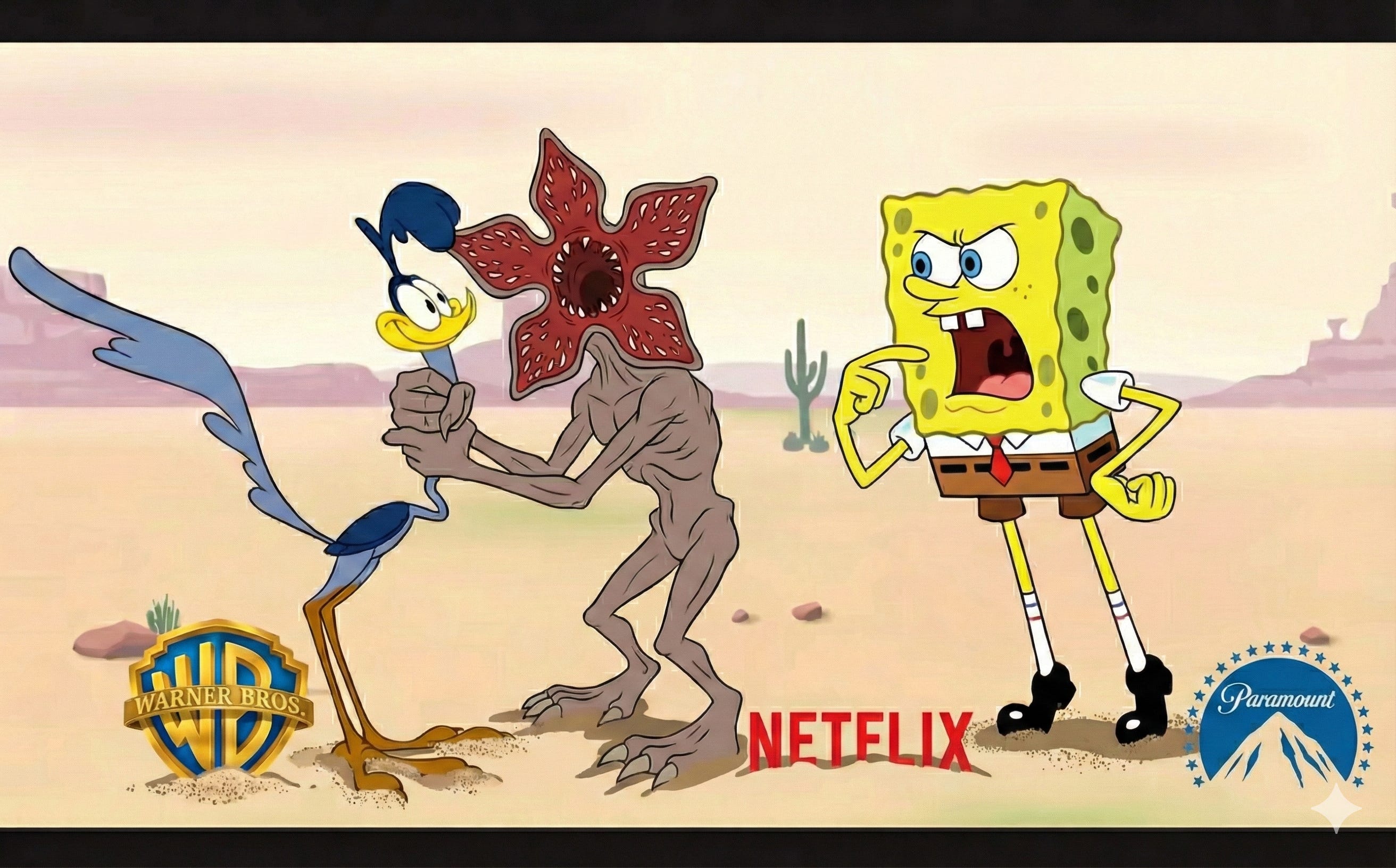
A big battle is happening in Hollywood right now: Netflix and Paramount both want to buy Warner Bros.
Everyone is talking (and writing ;) about who will win, or if these deals can even close.
But for me, the interesting story is what this means for the MENA region. And it’s not that simple.
Today, I’ll share the key news since last Friday, explain the 2 deals from Netflix and Paramount and, most importantly, show why it matters for streaming in MENA, especially for OSN+.
Read on to learn about:
What’s the deal(s)? A simple timeline of the Netflix and Paramount deals, and how the situation changed over the last few days.
Global Giants in MENA: Where Warner Bros., Netflix and Paramount stand in the region today.
💡 So What? Why this global deal matters for MENA, and what could happen next for OSN+.
Today, most platforms in MENA use global CDNs to deliver movies, series and live sports. But the future of streaming in the region may be all about local delivery. Imagine this 👇
✅ Fewer errors
🖼️ Better picture quality
📍 More stable streaming
⚡️ Videos that start faster
🔒 Data that stays local and protected
This is becoming more important as streaming grows fast, and global outages continue to affect platforms everywhere.
The good news? CDN companies are already building this future in MENA.
With stronger networks, more local delivery points and better tools to keep platforms fast and reliable 🙌
Want the full insight?
I explain everything in my new whitepaper, The Power of Locally-Optimized CDN in MENA, created with insights from regional CDN experts like Medianova

What’s the deal(s)?
Let’s save time and go straight to the key updates:
On December 5, Netflix entered exclusive talks to buy Warner Bros. Discovery, overtaking bids from Paramount and Comcast.
The company then confirmed an $82.7B agreement to acquire Warner Bros., HBO/HBO Max and WB Games.
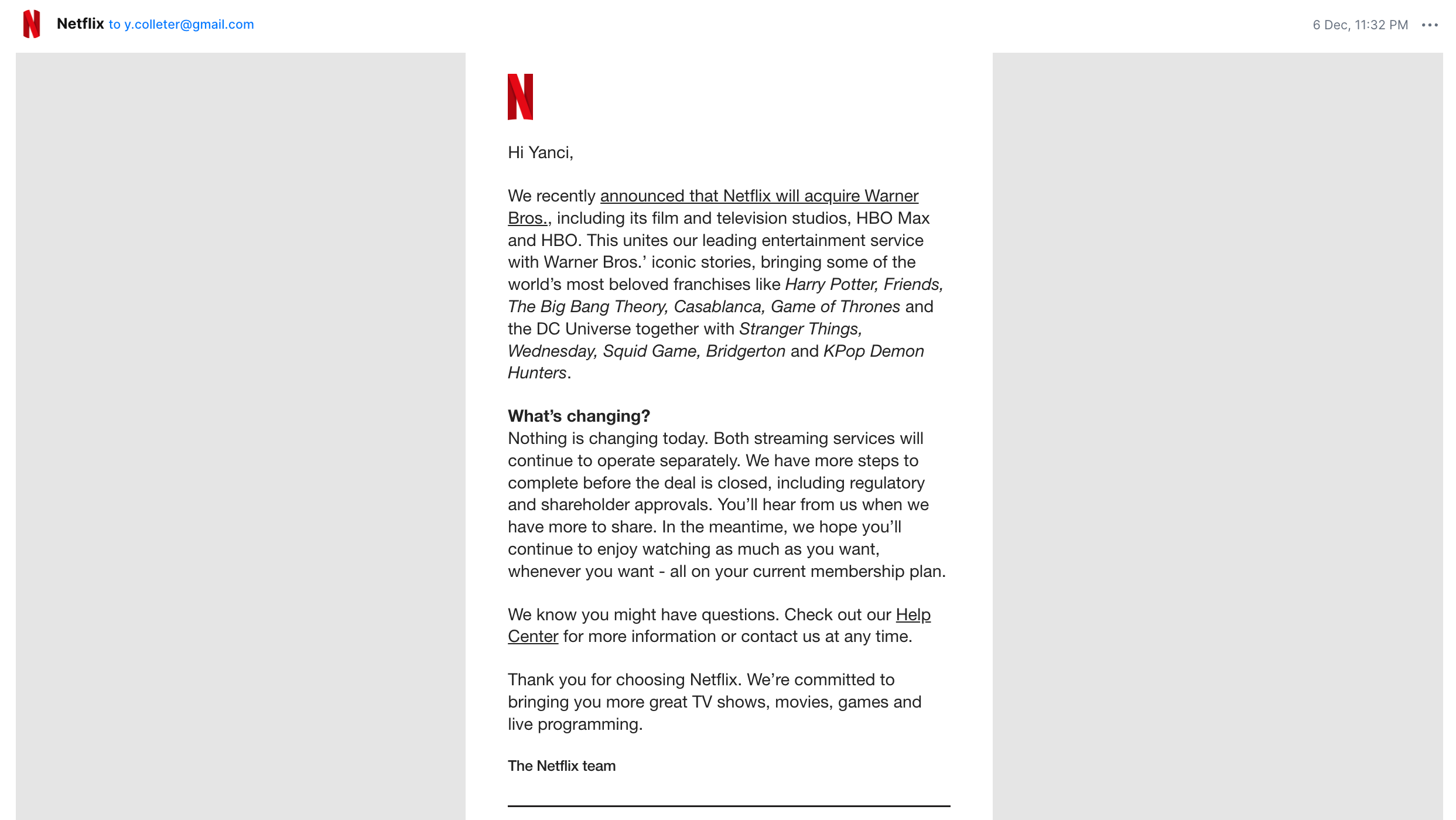
On December 6, Netflix emailed its entire subscriber base to “explain” the deal, plus shared a full FAQ on its website.
On December 8, President Trump publicly warned that the Netflix–Warner Bros. merger “could be a problem” due to market share.
A few hours later, Paramount escalated the situation by launching a $108B hostile takeover offer for all of WBD.
Warner Bros. Discovery responded by saying it would review the proposal and get back within 10 business days.
Netflix’s leadership, meanwhile, insisted they are “super-confident” the deal will go through, promising to protect jobs, support theatrical releases, and keep Warner Bros. free to license shows to other platforms.
By December 9, Trump refused to choose sides, saying he would personally take part in the regulatory review.
Today, unions are warning that both deals are bad for workers, saying they could mean fewer buyers, fewer projects and more pressure on wages.
I also read that David Ellison spent 12 weeks trying to win WBD with 6 offers and personal meetings with Zaslav, but the board still chose the lower Netflix bid, which explains why Paramount has now gone hostile and taken its offer directly to shareholders.
Now let’s look at both proposals: the deal size, assets, funding, expected impact, and the main challenges.
Netflix × Warner Bros.
Netflix is offering $82.7B, or $27.75 per share, to acquire the Warner Bros. studio, HBO/HBO Max and WB Games.
The linear networks (CNN, TNT, TBS, Discovery Channel) are not included and will move into Discovery Global in 2026.
The deal is funded through a mix of cash and Netflix stock, plus financing from Wells Fargo, BNP and HSBC.
If successful, Netflix would add 128 million WBD subscribers to its 300 million+ base, creating an even bigger global giant.
Netflix expects $2–3B in yearly savings, but here is the biggest challenge for them: regulators may push back hard as Netflix becomes even more dominant.
Paramount × Warner Bros. Discovery
Paramount is offering $108.4B, or $30 per share in cash, to buy the entire company: studio, HBO Max, games, and all linear networks.
The deal is backed by Saudi Arabia, Qatar, Abu Dhabi, RedBird and Larry Ellison, with an additional $54B in bank financing.
If completed, it would create a group with around 200 million streaming subscribers and generate an estimated $6B in savings.
The real challenge for Paramount is time: they need rapid shareholder support to beat Netflix’s head start.
Global Giants in MENA
Let’s zoom out and look at the region.
Streaming in MENA is more fragmented than ever. Today, there are more than 100 active platforms, and about two-thirds are local.
The ecosystem is also starting to consolidate. We now have bundles like Shahid × Netflix and Yango Play × Crunchyroll, while ADtv has fully moved into STARZPLAY.
Something important: HBO Max, Paramount+ and other global streaming giants are not available in MENA yet.
Launching direct-to-consumer here is expensive, from losing licensing revenue, to marketing costs, to building local teams and securing telco distribution. This is why many global players still prefer licensing over going D2C in the region.
OSN+ is the exclusive home of HBO and one of Warner Bros. most important partners in the region. The service offers HBO Originals, Max Originals, the Warner Bros. film catalogue, some DC and The CW titles, etc.
Earlier this year, WBD strengthened this relationship by taking a 30% stake in OSN+ for $57M, with plans to co-invest in premium local productions. The deal is still being completed.
Paramount, meanwhile, has a limited footprint in MENA. Its content is spread across different platforms, and its attempt to secure a major regional deal didn’t succeed.
The merger with Skydance also made things more complicated, leading to many Paramount team members in the Dubai office losing their roles.
💡 So What? The Real Impact in MENA
Now to what matters for the region.
It’s rare to see Saudi Arabia, Qatar and the UAE backing the same media deal. It shows the Ellison family’s influence and how aggressively Paramount is moving.
But what does MENA get out of this?
Hard to say financially. But in media, power and influence are often more important than direct revenue.
Now let’s look at consumer and industry impact 👇
🥇 If Netflix wins
Netflix may decide to keep HBO content on OSN+ for a while, especially during integration. But once existing contracts expire, they could move HBO and Warner Bros. content directly onto Netflix.
This would be a huge hit for OSN+, which relies heavily on HBO as its premium differentiator.
Another big question is the WBD investment in OSN+. Since the deal is still in progress, Netflix could pause, change, or cancel it.
Strategically, Netflix has no reason to own 30% of a regional competitor. Even if the deal closes, they could always sell the stake back later.
🥇 If Paramount wins
Things look very different.
Paramount would instantly control Paramount+ and HBO Max, and could use OSN+ as its regional streaming hub instead of launching new platforms from scratch.
OSN+ already has the right distribution, brand and local operations.
A bold but realistic scenario is that Paramount acquires 100% of OSN and merges OSN+, Paramount+ and HBO Max into one super streamer for the region. This would be one of the biggest media consolidations ever seen in MENA, combining global franchises with regional strength.
In this case, HBO content is much more likely to remain on OSN+ and even expand, because Paramount relies heavily on international partners.
Before you leave, tell me:
Wishing everyone a great week! See you online this Friday for a new edition of my Streaming in Short.


